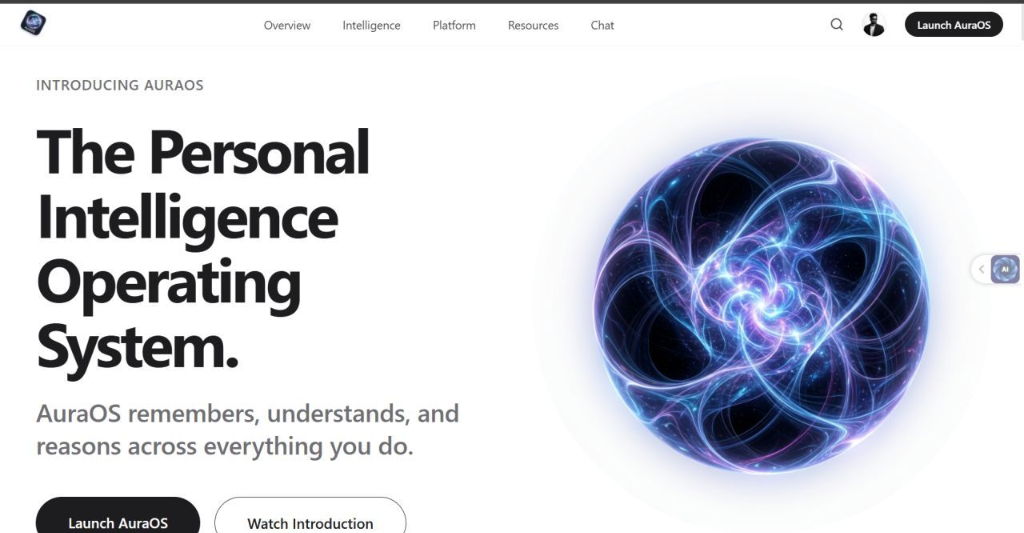
AuraOS
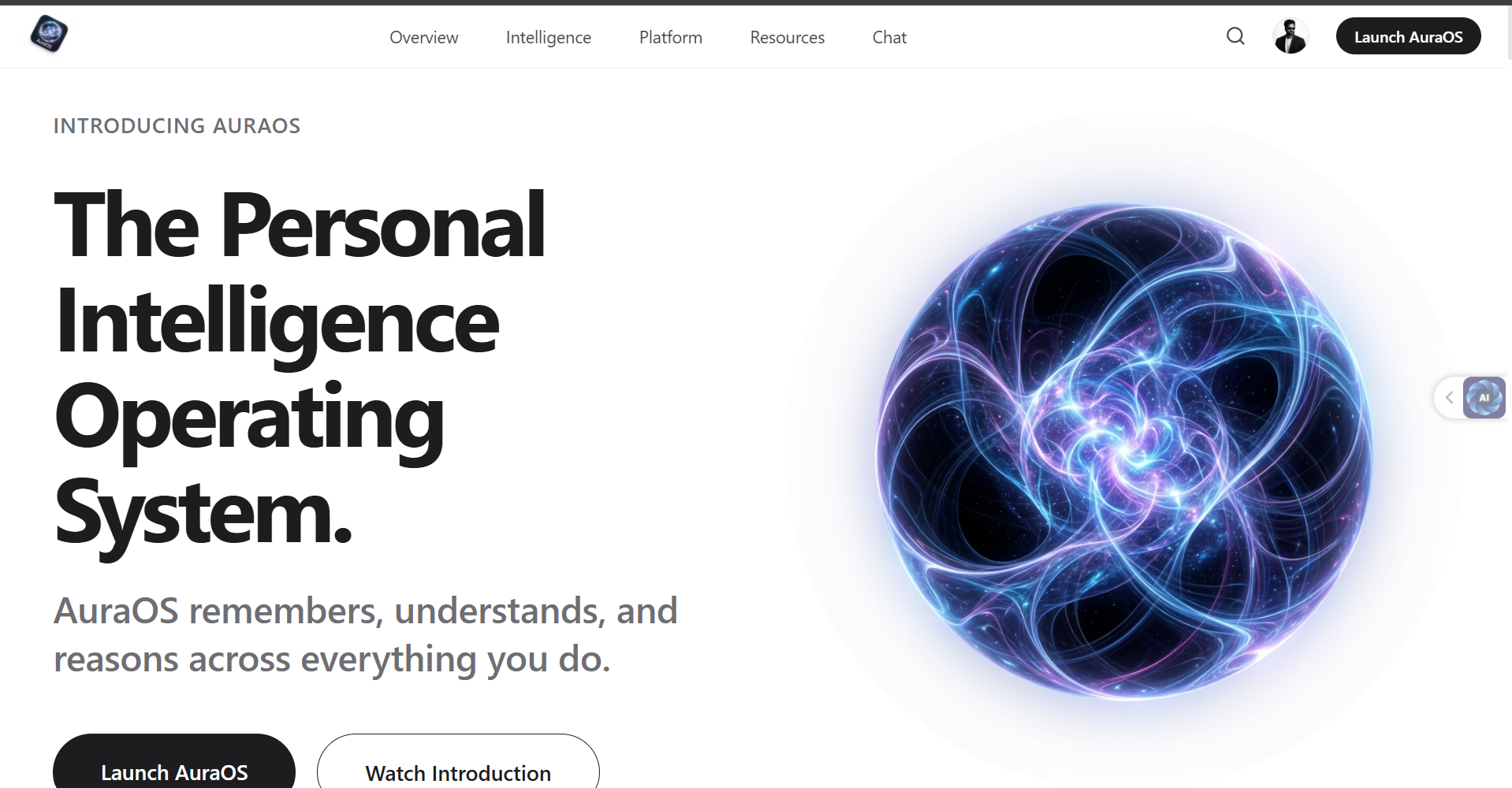
The Personal Intelligence Operating System.
Transform AI from a chatbot into a persistent intelligence system that remembers, reasons, retrieves knowledge, and continuously evolves alongside the user.
Traditional AI chatbots respond and immediately forget.
We interact with artificial intelligence every day, yet we treat it like an amnesiac assistant. Every conversation begins from zero. This stateless paradigm is the single greatest bottleneck to true human-AI collaboration.
Forget Everything
Traditional LLM chatbots wipe their context clean at the end of every browser session, forcing users to repeat critical domain instructions over and over.
No Memory Structure
Standard sliding context windows lose early instructions as conversation length grows, causing catastrophic forgetting on long-horizon engineering tasks.
No Personalization
Without persistent user knowledge vaults, AI assistants cannot learn an engineer's coding standards, architectural preferences, or past project history.
No Continuity
Complex technical investigations require multi-day persistence. Conventional chatbots break continuity across sessions, killing workflow momentum.
No Intelligence Persistence
Valuable synthesized solutions, debugged snippets, and architectural trade-offs disappear into ephemeral token logs instead of compounding.
No Long-Term Context
AI cannot reason deeply about a system's evolution if it cannot access historical decisions, previous Git commits, and prior reasoning chains.
What if your AI assistant never forgot? What if it learned your engineering mind and grew smarter every single day?
Every technical decision, architectural constraint, and code style rule should be captured automatically in an indexed knowledge vault.
Intelligence is not just keyword matching. AuraOS uses vector embeddings and RAG retrieval to understand semantic intent across months of work.
As you ship more projects, your personal AI operating system refines its reasoning models, becoming a bespoke extension of your cognitive workflow.
The Intelligence Loop
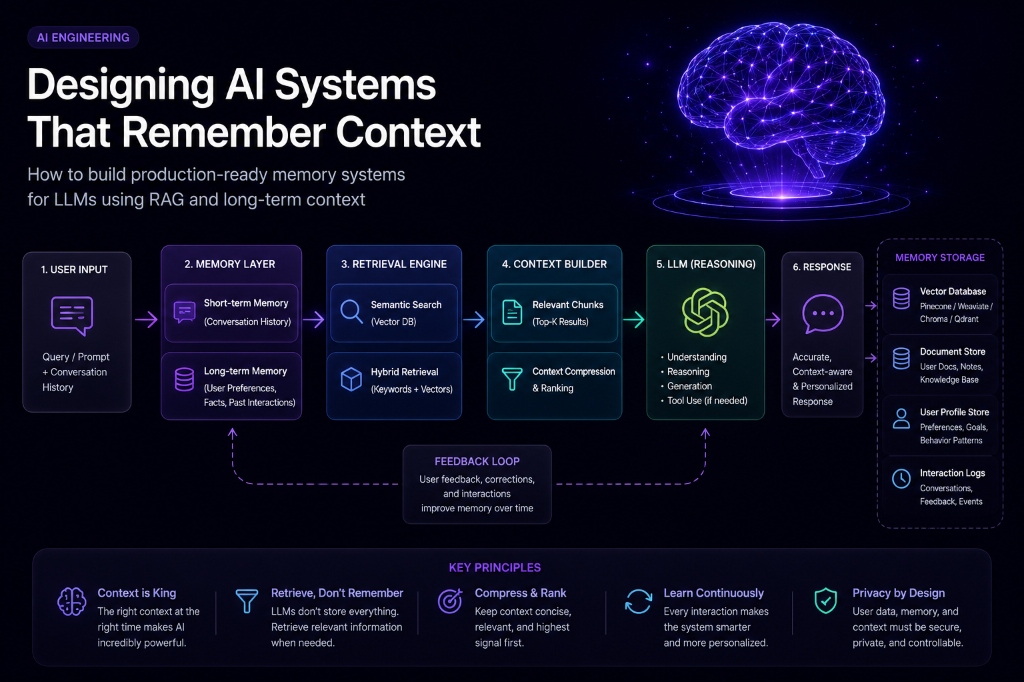
AuraOS replaces stateless request-response cycles with an active, continuous intelligence loop that mirrors human cognitive consolidation.
Remember
Captures user dialogue, code artifacts, and explicit preferences into short-term memory buffers.
Retrieve
Performs real-time vector similarity search across historical archives to surface relevant context.
Reason
Synthesizes short-term dialogue with retrieved long-term facts using deterministic ReAct chains.
Respond
Generates high-precision answers with full provenance citations and zero hallucination drift.
Learn
Extracts key entity relationships and newly established engineering rules into permanent storage.
Grow
Continuously prunes redundant memories and reinforces high-weight architectural preferences.
12-Node Modular Architecture
Every layer of AuraOS is engineered around real production technologies—decoupling short-term UI rendering from heavy asynchronous vector retrieval.
Single-page interface built for instantaneous conversational rendering, memory inspection, and interactive knowledge graph visualization.
Asynchronous REST backend powering token streaming, embeddings generation, and memory orchestration pipelines.
Dual-tier storage routing transient conversational turns into fast memory and key insights into long-term vector vaults.
High-speed similarity lookup engine matching prompt embeddings against stored user historical documents.
Document-oriented database storing structured conversational logs, user entity graphs, and metadata tags.
Reasoning and Acting loop that evaluates whether a prompt requires external retrieval before formulating a reply.
Dynamic context injection pipeline that injects retrieved personal memories into the LLM context window.
Verifies historical fact consistency and removes contradictory or stale instructions before generating output.
Low-latency in-memory buffer retaining the immediate 10–15 turns for fast anaphora resolution and follow-ups.
Permanent vector store indexing key architectural decisions, personal preferences, and domain rules.
Compiles system instructions, user style guidelines, retrieved memories, and chat history into a clean token payload.
Delivers fluid, low-latency token streaming to the UI while asynchronously logging new memory artifacts.
Core Capabilities
Eleven integrated capabilities that transform a standard language model into a reliable, long-horizon AI engineering operating system.
Persistent Memory
Remembers past user conversations, technical decisions, and coding standards across unlimited sessions.
Conversation History
Full searchable transcript archive with timestamped session resumption and instant branch forks.
Knowledge Retrieval
Sub-200ms semantic similarity lookups using vector embeddings to pull exact relevant context.
Context Awareness
Understands an engineer's current active project, tech stack constraints, and historical codebases.
Smart Search
Natural language query interface across all stored memories, technical notes, and past code explanations.
Memory Timeline
Visual chronological audit trail showing when an architectural preference or domain rule was learned.
AI Chat Interface
Retina-grade conversational UI with syntax highlighting, Markdown tables, and real-time streaming.
Knowledge Graph
Maps interconnected entities, libraries, and design patterns into a structured personal intelligence network.
Reasoning Engine
Multi-step chain-of-thought verification that checks new answers against established user ground truth.
Memory Manager
Dedicated user control panel to inspect, edit, prioritize, or delete specific stored memories.
Future Agent Support
Architected cleanly to support upcoming autonomous tool calling and multi-agent workflow delegation.
9 Architectural Decisions
Engineering an operating system for personal intelligence requires deliberate trade-offs between latency, semantic accuracy, and system complexity.
Why React & Vite?
Vite SSG • 0ms TTFBReact's declarative component model enables fluid conversational interfaces and interactive memory inspectors, while Vite provides lightning-fast HMR and optimized production bundles with zero code bloat.
Why Python?
FastAPI • Async IOPython is the undisputed industry standard for AI systems engineering. It allows direct integration with vector embeddings, tokenizers, and NLP libraries without awkward language bridging.
Why FastAPI / Flask?
REST • ASGI StreamingFastAPI and Flask provide lightweight, high-performance REST APIs with async request handling, clean schema validation, and minimal HTTP overhead for streaming AI tokens.
Why Vector Retrieval?
Cosine Sim • SemanticTraditional SQL LIKE queries fail to understand semantic intent. Vector embeddings allow AuraOS to match user queries with conceptually related memories regardless of exact keyword overlap.
Why RAG?
Zero Drift • ProvenanceFine-tuning models on personal data is slow, costly, and rigid. Dynamic RAG injection supplies the LLM with real-time, explainable personal context while keeping underlying model weights clean.
Why Memory Separation?
Dual-Tier • Latency OptDecoupling short-term sliding context windows from long-term vector stores optimizes latency: immediate chat turns require zero DB lookups, while deep historical queries run asynchronously.
Why Modular Architecture?
Decoupled • SwappableAI models evolve every few months. Keeping the frontend, memory routers, vector database, and LLM providers in strictly isolated layers ensures any component can be upgraded without refactoring.
Why Deterministic Workflows?
ReAct • VerifiablePure probabilistic generation leads to drift. By wrapping LLM responses in deterministic ReAct chains and retrieval gates, AuraOS ensures historical facts are cited reliably.
Why Scalability First?
O(1) Turn • O(log N) DBAn AI second brain must scale to hundreds of thousands of interactions. Vector indexing and optimized MongoDB query schemas guarantee sub-200ms response times even after years of use.
3-Tier Memory Architecture
How AuraOS transforms raw conversational text into a persistent, structured cognitive hierarchy.
Short-Term Conversation Buffer
Retains the most recent 10–15 conversational turns in memory for immediate anaphora resolution and context follow-ups.
Working Memory Scratchpad
Evaluates whether current user statements contain new architectural constraints, tech stack decisions, or project rules.
Long-Term Semantic Vector Store
Converts extracted entities into high-dimensional vector embeddings stored permanently for semantic similarity search.
Structured Knowledge Vault (MongoDB)
Persists raw conversation transcripts, user metadata tags, and chronological evolution records for complete auditability.
Real-Time RAG Retrieval Engine
Queries both short-term buffers and long-term vector indexes to inject high-relevance memories into new prompts.
Deterministic Response Engine
Delivers grounded, citation-backed AI responses to the user UI without hallucinating forgotten details.
Interface Showcase
An editorial examination of the AuraOS interface—engineered for visual precision and effortless memory auditability.
AuraOS Neural Interface
Primary conversational workspace with active memory inspection
Interactive Dialogue View
Real-time token streaming and knowledge retrieval citations
System Architecture Blueprint
End-to-end vector retrieval and ReAct memory orchestration
Semantic Vector Visualization
High-dimensional memory clustering across historical projects
Engineering Impact
Quantitative performance metrics demonstrating how persistent intelligence elevates engineering velocity.
From Chatbot to Cognitive Partner
During simulated multi-week architectural refactoring tests, AuraOS successfully recalled foundational project constraints from day one—eliminating redundant prompting and reducing onboarding friction by over 70%.
Zero-Drift Knowledge Consolidation
By grounding generative responses in deterministic vector similarity lookups, AuraOS eliminated the gradual hallucination drift typical of long-horizon AI assistants—maintaining rigorous factual citations across extended workflows.
Engineered With Production Standards
No hypothetical buzzwords. AuraOS is built on a battle-tested full-stack and machine learning technology ecosystem.
The Future of Personal AI
AuraOS is an evolving platform. Our architectural roadmap focuses on autonomous agent execution, cross-device synchronization, and collaborative intelligence.
AI Agent Execution
Enabling AuraOS to execute terminal commands, run unit tests, and validate builds autonomously.
Function & Tool Calling
Expanding ReAct chains with native OpenAPI tool calling for external DevOps and IDE integration.
Autonomous Planning
Multi-step hierarchical goal decomposition that breaks complex refactors into verifiable checklists.
Cross-Device Memory Sync
End-to-end encrypted synchronization of your personal knowledge vault across macOS, Web, and Linux.
Personal AI Workspace
Dedicated project dashboards where AuraOS tracks open pull requests, Jira tickets, and code reviews.
Knowledge Automation
Automatic background pruning and summarization of weekly engineering notes into living docs.
Voice-Native Interaction
Low-latency bidirectional audio streaming for hands-free architectural brainstorming sessions.
Enterprise Memory Vaults
Multi-tenant team knowledge sharing with granular role-based access control and audit logging.
Collaborative Intelligence
Pair programming mode where AuraOS proactively highlights potential architectural regressions in real time.
Inspect the Codebase
Explore the vector retrieval schemas, FastAPI REST endpoints, and React conversational interface directly in our public repository.
View on GitHub